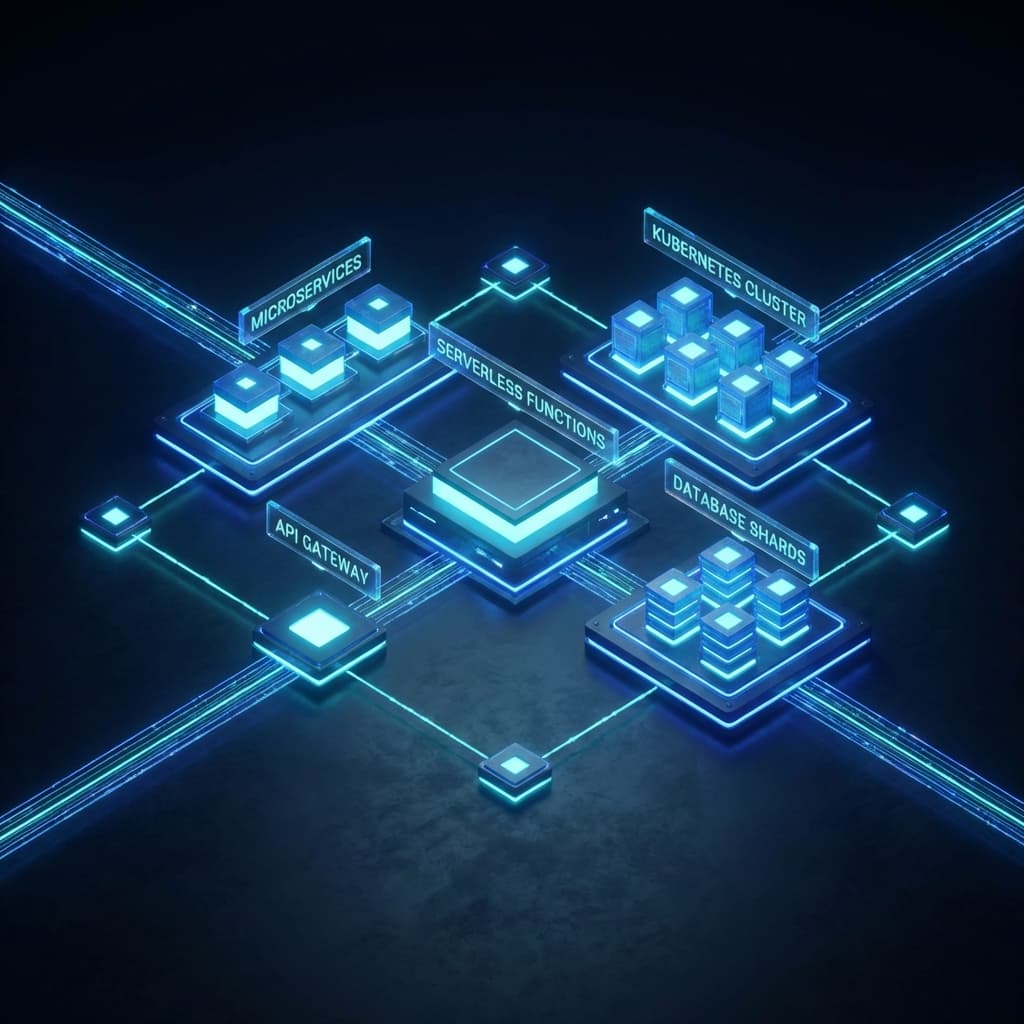
Migrating 500k students from a monolith to microservices without downtime.
The Challenge: A Monolithic Anchor
Our client, a rapidly growing EdTech platform with over 500,000 active students, was a victim of their own success. Their entire platform was built as a single, massive Ruby on Rails monolith. As student numbers grew, the system became increasingly fragile. A single bug in the "Discussion Forum" could take down the "Video Streaming" service. Deployments took over 4 hours and required a "code freeze" for the entire engineering team. Scaling meant throwing more expensive RAM at a single instance.
They needed to migrate to a modern microservices architecture to improve velocity, reliability, and cost-efficiency. But there was a catch: the platform had to stay 100% online. In the competitive EdTech world, even 30 minutes of downtime means thousands of students switching to a competitor.
The Strategy: The Strangler Fig Pattern
We chose the "Strangler Fig" pattern for the migration. Instead of a "Big Bang" rewrite (which almost always fails), we decided to gradually "strangle" the monolith by extracting one service at a time. The monolith remains in place, but new functionality is built in microservices, and existing functionality is gradually moved over.
The first component we extracted was Authentication and User Management. We built a new "Identity Service" in Go and placed an API Gateway (using NGINX and custom Lua) in front of the entire system. Initially, the gateway passed 100% of traffic to the monolith. Once the identity service was ready, we configured the gateway to route all '/auth' requests to the new service while keeping everything else on the monolith. This was our "Point of No Return," and it was a success.
Phase 2: Content Delivery and Video Streaming
The next priority was the video streaming engine—the most resource-intensive part of the app. We extracted the content delivery logic into a dedicated "Content Service" running on Node.js and AWS Lambda. We integrated with a global CDN and implemented adaptive bitrate streaming.
By offloading the heavy video traffic to a specialized service, the load on the Rails monolith dropped by 60%. Suddenly, the remaining app was faster and more responsive, even before we touched any other code.
Phase 3: Database Migration with CDC
The hardest part of any migration is the data. The monolith used one giant PostgreSQL database. To move services like "Progress Tracking" and "Gamification," we needed to move their data too. We used Change Data Capture (CDC) via Debezium and Kafka.
We set up a real-time sync between the monolithic DB and the new service-specific databases. For 30 days, we let the services run in "Shadow Mode"—they processed requests and updated their databases, but the results weren't used yet. We compared the results of the old and new systems until we had 100% parity. Then, with a simple DNS flip, the new services became the "Source of Truth."
Technical Stack Transition
As part of the migration, we transformed more than just the architecture:
- Language: Transitioned from Ruby/Rails to Go for high-performance services and TypeScript/React for the frontend.
- Infrastructure: Moved from static VMs to Kubernetes (GKE on Google Cloud).
- CI/CD: Optimized pipelines using GitHub Actions, reducing deployment time from 4 hours to 10 minutes.
- Observability: Implemented full distributed tracing with Jaeger, allowing us to see exactly where a request is slowing down across the new microservices.
The Human Aspect: Upskilling a Monolithic Team
A major migration is as much about people as it is about code. Our client's engineering team had spent five years working on a single Ruby on Rails codebase. Switching to a microservices architecture in Go required a massive upskilling effort. We didn't just write the code and leave; we embedded ourselves with their team for six months.
We established "Community of Practice" groups for Go development, Kubernetes orchestration, and DevOps automations. We held weekly lunch-and-learns and pair-programming sessions. By the end of the project, their team was not only comfortable with the new architecture but was already building new services independently. This cultural transformation is what ensures the long-term success of any digital modernization project.
Technical Nuance: The 'Zero-Downtime' Database Cutover
The most nerve-wracking part of the project was the final database cutover. To ensure zero downtime, we used a "Dual-Write" strategy combined with a "Sync-Check" background job. For the final 48 hours, the system wrote data to both the old monolithic database and the new microservice databases simultaneously.
A background worker continuously scanned both databases to identify and resolve any discrepancies in real-time. When we were confident that the new databases were perfect mirrors of the old ones, we performed the cutover in the middle of a Tuesday afternoon during peak traffic. Because of our rigorous testing and dual-write strategy, the switch was completely invisible to the 500,000 students on the platform. No maintenance mode, no error messages—just a faster, more stable platform.
Infrastructure as Code: The Foundation
The entire platform's infrastructure was rebuilt using Terraform and Helm. This "infrastructure as code" approach means that a developer can spin up a perfect clone of the entire production environment for testing in under 15 minutes. This has eliminated the "it works on my machine" syndrome and provided a stable foundation for the new microservices architecture. It also allowed us to implement rigorous automated security scanning and compliance checks into every build.
Impact: Agility at Scale
After 6 months of gradual migration, the transformation was complete:
- Downtime: Zero minutes of downtime during the entire 6-month process.
- Deployment Velocity: Increased from 1 deployment per week to 50+ deployments per day.
- Reliability: System uptime increased from 99.5% to 99.99%. A failure in one service no longer affects the rest of the platform.
- Costs: Infrastructure spend was reduced by 35% through better resource utilization on Kubernetes.
- Scaling: The platform recently handled a surge to 2 million concurrent students during a national exam period without any manual intervention.
Conclusion: The Architecture of Success
This project proved that you don't have to choose between moving fast and staying stable. By using the Strangler Fig pattern and investing in robust data migration tools, we were able to modernize a massive legacy system without the risk of a "Cold Cutover."
The client now has a platform that is ready for the next 10 years of growth. They can experiment with new features in hours, rather than weeks, and their engineering team is once again focused on innovation rather than fire-fighting.
Found this helpful?
Share this article with your network